Why Data Center Cooling Strategies May Be Putting Your Hardware at Risk
Data centers are balancing several competing priorities right now. They need to support rapidly growing demand while also reducing energy use and lowering carbon emissions. That push has led operators to rethink how they approach data center cooling, from running systems a little warmer to bringing in outside air to reduce the load on traditional cooling systems.
While that all sounds good on paper, there is a catch. Some of the same strategies that improve data center energy efficiency can also create new risks. When data centers use free cooling and pull in outside air, they also bring in contaminants that can slowly wear down sensitive electronics. Over time, this can shorten the lifespan of equipment and increase the environmental cost of running data centers.
Increasingly, data center operators are turning to solutions like advanced air purification and plasma-based systems to help close the gap between efficiency and protection.
The Push for Greener Data Center Cooling
The shift toward greener operations is necessary as data center energy consumption continues to rise alongside global demand for cloud computing, AI workloads, and digital services. Operators are being asked to do more with less, including reducing emissions, taking pressure off the power grid, and hitting aggressive sustainability benchmarks.
That’s where modern data center cooling systems come in. To improve efficiency, facilities are turning to strategies like:
Air-side economizers that bring in outside air when conditions allow
Free cooling data center designs that reduce mechanical refrigeration
Raising operating temperatures to reduce the cooling load
Liquid cooling systems for high-density racks
Heat reuse initiatives to capture and repurpose waste energy
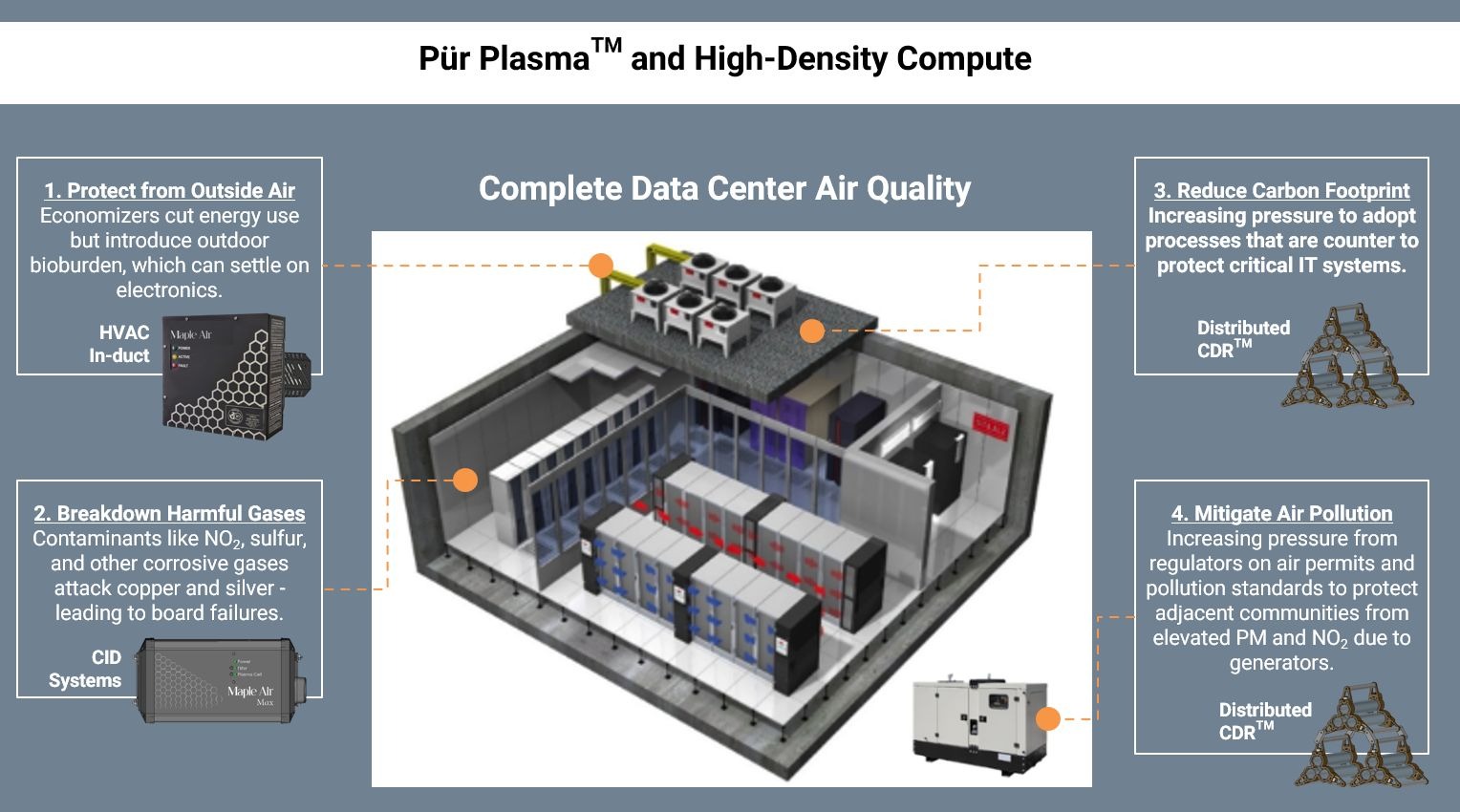
These smart, proven approaches lower operating costs and support sustainability goals. However, they shift the environmental burden from energy use to air quality management and increase exposure to external risks.
What Comes in With the Outside Air
When outside air enters a facility through an air-side economizer, it brings a mix of airborne contaminants that can impact both data center reliability and the sensitive equipment inside it.
These typically fall into three categories:
1. Bioburden
These include bacteria, fungal spores, and mold. While hazardous to health, these contaminants also create organic buildup on sensitive data center equipment.
2. Gaseous Pollutants
Sulfur oxides (SOx), nitrogen oxides (NOx), and other reactive gases are a bigger concern. These compounds are especially damaging to electronics. Over time, they can lead to:
Copper corrosion in data centers, particularly on circuit board traces
Sulfidation of conductive materials
Degradation of connectors and contacts
Even at low levels, these reactions can build up over time and lead to intermittent failures that are difficult to diagnose. This type of corrosion also represents a hidden efficiency cost, since damaged components often require early replacement or increased redundancy.
3. Particulate Contamination
Dust, fine particles, and industrial pollutants can settle on components, insulating heat-generating parts and interfering with performance.
Organizations like the American Society of Heating, Refrigerating and Air-Conditioning Engineers (ASHRAE), through its TC 9.9 committee, have published guidelines for acceptable environmental conditions in IT environments. The guidance highlights both particulate and gaseous contamination in data centers as critical factors in maintaining hardware integrity.
This is an important reminder that the air a facility brings in doesn’t just pass through; it also interacts with equipment at a chemical level.
Why Conventional HVAC Filtration Falls Short
Most data center facilities already have filtration in place. Standard HVAC air filtration systems, often rated by MERV, do a good job of capturing particles like dust and pollen. HEPA filters are even more effective at this, especially when it comes to very fine particulates.
But there is a gap. These systems are designed for buildings, not for mission-critical electronics. They primarily target particulates, not gases.
That means harmful compounds like sulfur dioxide and nitrogen oxides can pass straight through. These molecules are far smaller than what standard filters are designed to capture. As a result, even facilities with strong industrial air filtration can still experience corrosion-related issues.
Gaseous contamination poses a significant threat to mission-critical facilities. Unlike visible particle buildup, it goes unnoticed until damage occurs, resulting in compromised reliability and increased long-term energy costs due to degraded system efficiency.
Why Clean Air Should Be Part of Data Center Reliability
Because of the risks linked to poor indoor air quality, data center operators are starting to pay much closer attention to it, leading to a more complete approach to data center risk management that includes things like:
Gas-phase filtration using specialized media
Activated carbon filters that help capture gaseous pollutants
Air quality monitoring systems that track contamination in real time
Design strategies that balance efficiency goals with environmental protection
This approach is often referred to as filtration-first sustainability.
Facilities no longer choose between efficiency and reliability; they demand both. By cleaning air before it enters the space, operators can safely utilize economization and higher temperatures without risking equipment. Clean air is the missing control in the sustainability equation.
In other words, clean air is becoming a form of infrastructure resilience.
How Plasma Air Purification Addresses the Full Contamination Spectrum
Traditional filtration and gas-phase systems each handle part of the problem. Newer technologies aim to address a wider range of contaminants in a more complete way.
One example is Maple Air Pür Plasma, a true plasma air purification system designed for continuous, whole-space treatment, including data centers.
Instead of only capturing particles at a single point, Pür Plasma works throughout the surrounding environment. As air moves through the HVAC system, it creates a stable, energized plasma field that generates high electron energy and oxidized molecules. The high electron energy is able to break down harmful gases like VOCs to their constituent elements like oxygen. The oxidized molecules circulate through the space and break down airborne contaminants into simpler, harmless compounds.
Because this process runs continuously, the air is actively cleaned as it moves through the system and throughout the space over time.
Maple Air Pür Plasma™ can be installed directly in ductwork to treat an entire facility or used in targeted wall-mounted units for specific zones. By addressing both airborne contaminants and surface-level buildup, it reflects how particles naturally move between air and surfaces in real environments.
The system is also designed for use in occupied spaces. It is 100% ozone-free, which is especially important in environments with strict air quality requirements.
Independent testing has shown that Pür Plasma™ can deactivate airborne viruses in about one minute, which is significantly faster than some competing technologies such as PCO and ionization systems. In fast-moving environments like data centers, that speed matters because air is constantly circulating, and new contaminants are continually being introduced to the space.
For operators looking at long-term data center optimization, this approach offers a different way to manage contamination risk while supporting efficiency goals.
Cleaner Air for More Reliable Data Centers
As data centers continue to push for greater efficiency, air quality is becoming just as important as cooling strategy.
The challenge is not just reducing energy use. It is making sure those gains do not introduce new risks to the systems that keep everything running.
If you are exploring ways to reduce risk while improving performance, Maple Air Pür Plasma offers a proactive approach to managing airborne contaminants in mission-critical environments.
To learn more, contact info@getmapleair.com.
Effective across any indoor environment
Healthier air in Indian Trail, NC with Maple Air
1500 sq ft home
Air Bioburden (microbe units per cubic meter of air)
Industry standard: >300 = poor air quality, <100 = healthy air quality Lab: Scientific Air Solutions in Turlock, CA
Healthier air in Marvin, NC with Maple Air
4000 sq ft home
Air Bioburden (microbe units per cubic meter of air)
Industry standard: >300 = poor air quality, <100 = healthy air quality Lab: Scientific Air Solutions in Turlock, CA
Healthier air in Matthews, NC with Maple Air
5000 sq ft home
Air Bioburden (microbe units per cubic meter of air)
Industry standard: >300 = poor air quality, <100 = healthy air quality Lab: Scientific Air Solutions in Turlock, CA
Single Family Home
93.2%
Air improvement
70%
Surfaces improvement
Restaurant and Bar
90%
Air improvement
94.2%
Surfaces improvement
Commercial Gym
98.6%
Air improvement
99.6%
Surfaces improvement
College Athletics
97.9%
Air improvement
97.7%
Surfaces improvement
Dental Office
98%
Air improvement
99.3%
Surfaces improvement
Senior Living
92.1%
Air improvement
92.4%
Surfaces improvement
Food Delivery
90.4%
Air improvement
94.8%
Surfaces improvement
Percentage reduction in microbes per m3. Based on air and surface samples taken at each location before and after install. Audited reports by Scientific Air Solutions, Turlock CA
Not all air purifiers work the same, and the technology inside makes a big difference in what actually gets removed from your air. This guide compares the most common systems and explains which ones are best equipped to handle the full range of indoor pollutants.
If you’re comparing ozone generators and air purifiers, it’s important to understand they work in very different ways. This article breaks down how ozone systems operate, their limitations and safety concerns, and why plasma air purification offers a more practical solution for everyday, occupied spaces.
Electrostatic air cleaners capture particles by pulling them onto collection plates, but they don’t neutralize contaminants. Plasma systems like Maple Air’s Pür Plasma take a more advanced approach by actively breaking down pollutants in the air and on surfaces for more complete, continuous air treatment.
Available nationwide
Get healthier air in your most important space
Real world testing shows over 90% reduction of harmful microbes and indoor gases with Maple Air
Thank you! Your submission has been received!
Oops! Something went wrong while submitting the form.