AVAILABLE NATIONWIDE. INSTALLED BY LOCAL PARTNERS.
Get an Estimate

AVAILABLE NATIONWIDE. INSTALLED BY LOCAL PARTNERS.

Indoor air quality has become one of the biggest challenges facing modern buildings. Homes, gyms, offices, schools, and healthcare spaces are exposed to a growing mix of mold, bacteria, volatile organic compounds (VOCs), and combustion gases that didn’t exist at this scale just a few decades ago.
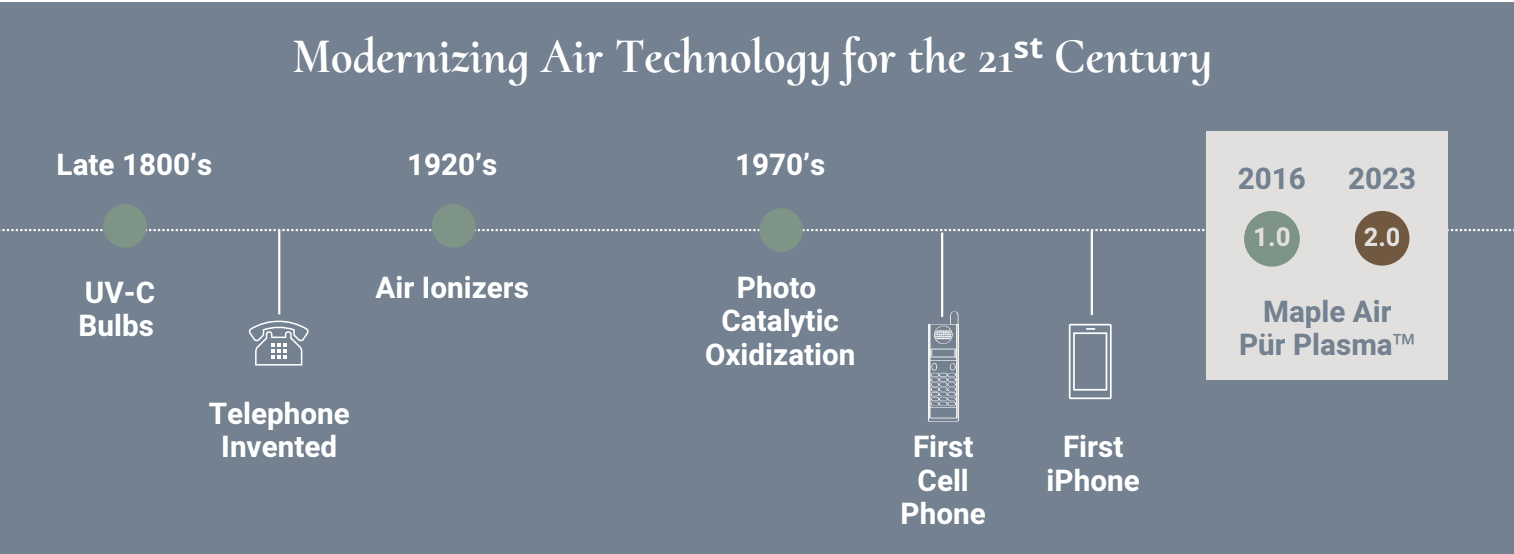
Unfortunately, rather than adopting modern solutions like Maple Air’s Pür Plasma™ air purification, many buildings still rely on air purification technologies that are more than a century old. While these systems may perform well in controlled settings like a lab the size of a bathroom, those conditions rarely match the scale and reality of occupied buildings. The real question is whether they actually work where air is moving, humidity changes, people are present, and everyday pollutants are constantly introduced.
The Maple Air Pür Plasma™ air purifier represents the first major indoor air quality breakthrough in over 50 years and is specifically designed to match how air moves and behaves in real buildings. It continuously treats both the air and surfaces without filters, bulbs, or unrealistic exposure times, offering reliable results in homes, offices, gyms, and schools alike.
Many products marketed as “plasma” are actually just ionizers. These systems work by charging particles so they fall out of the air or stick to a filter, but their effectiveness in real-world conditions is limited. Other systems rely on UV light to excite a metal strip, which can degrade rapidly over time or produce high levels of ozone to create a sanitizing effect.
Real plasma air purification works in a completely different way. Maple Air’s Pür Plasma™ is a true plasma air purifier, creating a stable, energized field that is powerful enough to charge electrons and ions and create oxidized molecules. These molecules neutralize and disinfect contaminants as air moves naturally through a space, breaking them down at the molecular level rather than simply trapping or moving them elsewhere.
Plasma is often called the fourth state of matter. In this system, the reactive molecules do the work instead of relying on mechanical capture or short-lived ions. Unlike ionizers, whose charged particles last only seconds, the oxidized molecules generated by the ozone-free, 100% organic Pür Plasma™ persist long enough to reach surfaces and neutralize pathogens. This extended lifespan helps reduce both airborne and surface microbes by more than 90%.
In addition to pathogens, plasma neutralizes harmful chemicals and gases. VOCs, formaldehyde, and gases – including carbon monoxide, nitrogen oxides, and radon – are constantly broken down, helping improve indoor air quality in ways traditional filters or other air quality technologies cannot. This means a plasma air cleaner can tackle a wider range of air quality challenges than most older air purifier technologies, making it the best plasma air purifier on the market.
Because performance stays steady over time, even in fast-moving HVAC systems where air is always circulating, a plasma system can scale to treat anything from a single room to hundreds of thousands of square feet, so it works equally well in homes and large commercial spaces such as gyms.
Unlike older technologies sometimes sold as “plasma,” Pür Plasma™ neutralizes contaminants without producing harmful ozone. Maple Air is UL 2998 no-ozone certified, an Environmental Claim Validation (ECV) program from UL Solutions that certifies air purifiers and cleaning devices emit zero ozone, meaning it operates safely across a variety of temperatures and humidity levels. Unlike older ozone generators, Pür Plasma™ maintains a stable, high-energy field that safely disinfects for the life of the system.
UV air purification has been around in some form since the late 1800s, working by damaging the DNA or RNA of microorganisms so they can’t reproduce.
Its effectiveness depends entirely on exposure time, intensity, and distance. In lab tests, viruses are usually easiest to inactivate, needing only seconds or minutes of exposure. Bacteria take longer, and mold or fungal spores can require 30 minutes or more of continuous exposure.
That’s where UV struggles in real-world HVAC systems. Air rushing through ductwork at 1,000 linear feet per minute doesn’t pause for UV light. In most homes and commercial systems, air passes a UV lamp in milliseconds – far too short to reliably inactivate viruses, bacteria, or mold. Some marketing suggests UV kills airborne pathogens in ducts, but physics simply doesn’t back that up.
UV is more effective on stationary surfaces. Lamps can help keep coils, drain pans, and air handler interiors cleaner because those surfaces receive constant exposure. Even then, UV bulbs start losing effectiveness from day one, and bulbs can look operational long after they’ve lost their germicidal strength. Replacing them every year adds to the ongoing costs.
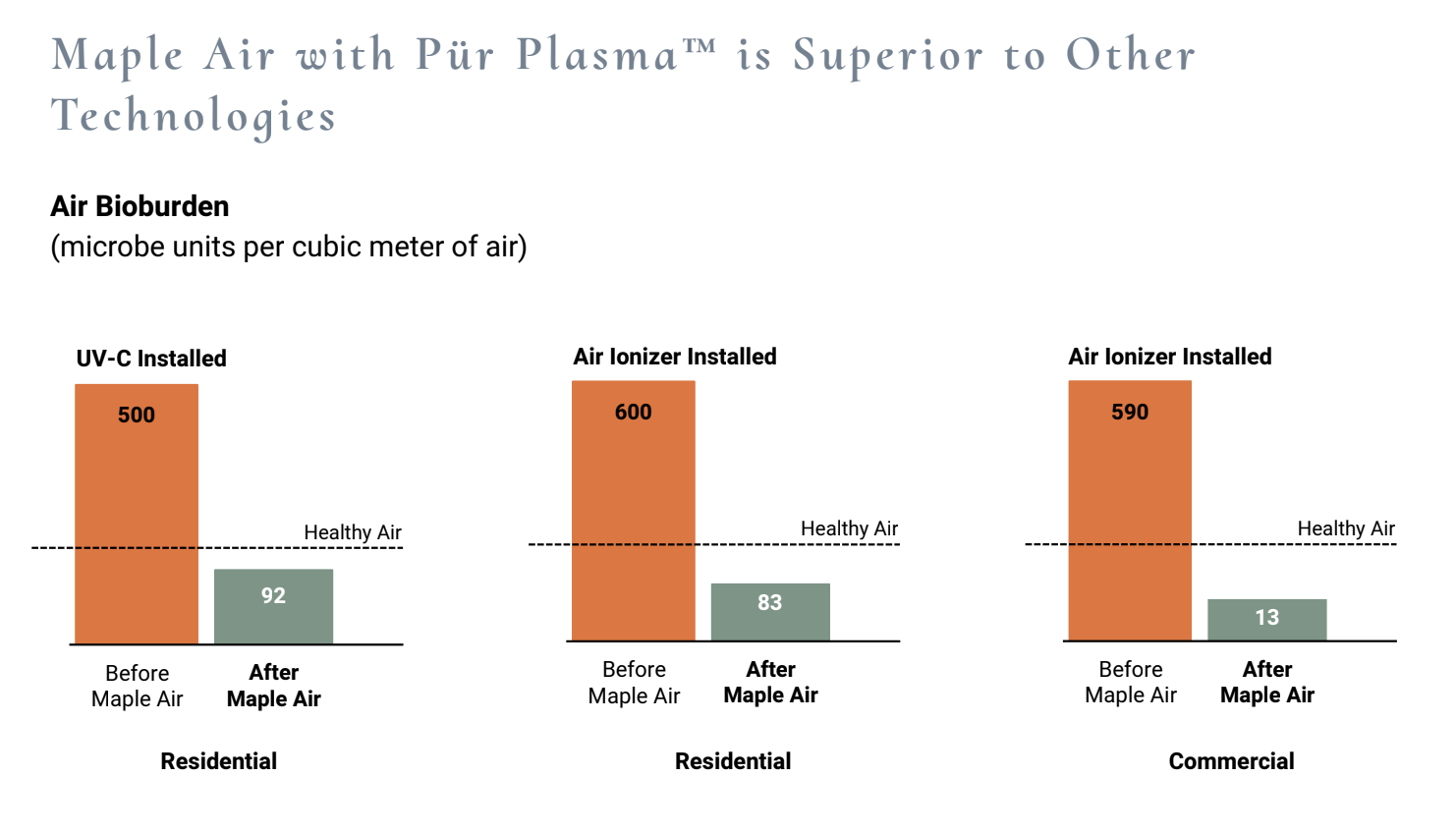
A real plasma air cleaner avoids these issues entirely. It doesn’t rely on exposure time or airflow speed. It treats air and surfaces continuously, no matter how fast the air is moving. There’s no decay in performance, and field testing shows plasma systems can disinfect and reduce bioburden up to 15 times more than UV in active spaces.
Ionizers and bipolar ionization systems release electrically charged ions into the air that attach to airborne particles. Once charged, particles may clump together, become more likely to deposit on surfaces, or be easier for HVAC filters to capture. Variations of ion-based air treatment have existed since the early 20th century.
The confusion starts with branding. Many systems marketed as “plasma” are ionizers. If a system’s primary function is generating ions, it should be evaluated as an ionizer, regardless of what the name suggests.
In controlled testing, ionizers can show reductions in airborne particles. In occupied spaces, however, they often fail to perform reliably. Ions have extremely short lifespans – often just seconds – so many never interact with contaminants before dissipating. Ionizers may help reduce some airborne particles, but their effectiveness varies by pollutant type and airflow conditions. They have limited impact on odors or gases and are not designed to provide consistent surface treatment, where many pathogens and contaminants can settle.
Their performance is also highly dependent on airflow, humidity, room layout, and occupancy, which makes results unpredictable from one space to another. Independent testing has shown that ionizers can be up to 15 times less effective at reducing biological contaminants compared to a true plasma air cleaner. Ozone generation is another potential concern with many ion-based systems.
True plasma air purification, by contrast, does not rely on short-lived ions. It continuously treats both air and surfaces and is designed specifically for occupied, everyday spaces where conditions change throughout the day. This makes it far more effective at reducing airborne and surface pathogens than ionizers can achieve.
PCO air purifiers use UV light and a titanium dioxide catalyst to generate trace amounts of hydrogen peroxide and other molecules that can break down pollutants. In theory, PCO can treat bioburden in occupied spaces, but it comes with significant limitations.
UV bulbs begin degrading immediately, reducing output while titanium dioxide surfaces lose effectiveness and require replacement. To meet ozone regulations, many PCO systems are intentionally throttled, which further limits performance. As a result, multiple units are often required to see measurable results in occupied environments, increasing installation and maintenance costs.
Because the reactive output is low and dependent on sustained UV exposure, PCO systems often struggle to keep pace with continuous pollutant introduction in active, occupied buildings. Their effectiveness can vary widely based on airflow, humidity, and maintenance condition, making results inconsistent from one space to another. Unlike plasma-based systems, PCO does not maintain a stable, high-energy field capable of continuous whole-space treatment.
Over time, the cost per square foot rises as bulbs and catalytic surfaces degrade.
HEPA filters are effective at capturing many common particles, including dust, pollen, and pet dander. Carbon filters can absorb some odors and chemicals.
Filtration has its limits. HEPA filters only clean the air that physically passes through them, which can leave dead spots in rooms or buildings where air circulation is weak. They can capture particles, but they don’t neutralize viruses, bacteria, or mold, and the smallest particles may still pass through. Standard filters also cannot remove most VOCs, formaldehyde, carbon monoxide, nitrogen oxides, or radon. Over time, clogged filters reduce airflow, increase energy use, and lower overall effectiveness unless replaced regularly.
This leads many people to ask, “Are HEPA air purifiers worth it?” The answer depends on the goal. For basic particle control in contained spaces, HEPA works well as a defensive solution. For whole-space indoor air quality, though, HEPA filters alone fall short.
Plasma air purification does not rely on air being pulled into a single device or filter. Available as in-duct or wall-mounted systems, Maple Air actively treats air and surfaces throughout the building, neutralizing particles and gases as they move through the space rather than collecting them in one location. In practice, the most effective approach is a layered one: Maple Air working offensively alongside a high-quality MERV filter to deliver complete, whole-building air treatment.
Improving indoor air quality means addressing a variety of pollutants, including particles, gases, and microbes. Different technologies handle these challenges in various ways:
The upfront price of an air purification system doesn’t always tell the full story. Some systems may seem affordable at first, but ongoing maintenance and replacements can quickly add up:
By contrast, Maple Air’s plasma system offers a simpler, more cost-effective approach:
While UV, ionizers, PCO, and HEPA were designed decades ago for controlled, still environments, modern buildings are far from static. Air moves quickly, people occupy spaces, and pollutants are constant and varied.
Plasma air purification was designed for these real-world conditions. It provides continuous treatment, neutralizes contaminants in both the air and on surfaces, breaks down gases and VOCs, and maintains consistent performance without constant maintenance.
For the world’s best air purifier built to perform in actual living and working spaces – not just lab tests – real plasma from Maple Air stands apart. It creates a stable, energized field that actively neutralizes contaminants in both the air and on surfaces as air moves naturally through a home or building.
Get an estimate on Maple Air’s Pür Plasma™ for your home or business. It’s available nationwide and installed by trusted local partners.


Healthier air in
Indian Trail, NC
with Maple Air
1500 sq ft home
Air Bioburden
(microbe units per cubic meter of air)
Industry standard:
>300 = poor air quality,
<100 = healthy air quality
Lab: Scientific Air Solutions in Turlock, CA


Healthier air in
Marvin, NC
with Maple Air
4000 sq ft home
Air Bioburden
(microbe units per cubic meter of air)
Industry standard:
>300 = poor air quality,
<100 = healthy air quality
Lab: Scientific Air Solutions in Turlock, CA


Healthier air in
Matthews, NC
with Maple Air
5000 sq ft home
Air Bioburden
(microbe units per cubic meter of air)
Industry standard:
>300 = poor air quality,
<100 = healthy air quality
Lab: Scientific Air Solutions in Turlock, CA



Air improvement
Surfaces improvement

Air improvement
Surfaces improvement

Air improvement
Surfaces improvement

Air improvement
Surfaces improvement

Air improvement
Surfaces improvement

Air improvement
Surfaces improvement

Air improvement
Surfaces improvement
Every Piece Is Unique


Not all air purifiers work the same, and the technology inside makes a big difference in what actually gets removed from your air. This guide compares the most common systems and explains which ones are best equipped to handle the full range of indoor pollutants.

If you’re comparing ozone generators and air purifiers, it’s important to understand they work in very different ways. This article breaks down how ozone systems operate, their limitations and safety concerns, and why plasma air purification offers a more practical solution for everyday, occupied spaces.
Available nationwide