AVAILABLE NATIONWIDE. INSTALLED BY LOCAL PARTNERS.
Get an Estimate

AVAILABLE NATIONWIDE. INSTALLED BY LOCAL PARTNERS.
Cigarette smoke can linger for hours. The odor can cling to furniture, clothing, and walls, and drift through ventilation long after a cigarette is gone. Many people searching for the best air purifier for cigarette smoke assume the goal is simply removing the smell.
In reality, the odor is only part of the problem. Cigarette smoke contains fine particles along with harmful gases and chemical compounds such as carbon monoxide, benzene, nitrogen oxides, and formaldehyde. These pollutants contribute to persistent smells, indoor air quality issues, and serious health risks such as cancer.
That’s why some air purifiers seem to help at first but don’t fully solve the problem. Many systems capture particles, while the gases responsible for odors and respiratory irritation remain in the air. Understanding this difference is key when choosing the right air purifier for cigarette smoke – and it’s where technologies like Maple Air’s Pür Plasma™ take a different approach.
Cigarette smoke contains more than 7,000 chemicals in both particle and gas form, many of which can affect the air you breathe and your health.
While visible smoke can begin to fade after an hour, tiny smoke particles, or secondhand smoke, can remain suspended for up to five hours and move easily throughout a room.
In addition to particles, tobacco smoke contains gases and volatile organic compounds (VOCs). Some of the most harmful include:
These contaminants behave differently from particles. Rather than settling or being trapped by filters, they spread through the air and settle on surfaces like furniture, carpets, and walls.
That’s one reason the smell of tobacco smoke can stick around, even after ventilating. Since smoke has both particles and gases, clearing it out completely requires more than just a standard air purifier.
Some air purifiers can help reduce cigarette smoke, but their effectiveness depends on the technology they use. Most traditional purifiers rely on filtration. HEPA filters capture tiny airborne particles, including ash and tar, which can make the air look clearer and reduce particulate exposure. However, while HEPA filters trap most smoke particles, they cannot remove all of them, especially ultrafine particles smaller than 0.3 microns.
The bigger challenge is the gases in smoke. Many odor- and irritation-causing compounds are volatile organic compounds (VOCs) that pass right through particle filters. Activated carbon can absorb some of these gases, but it has limited capacity and can become saturated quickly with frequent smoking.
Other technologies, like UV light, photocatalytic oxidation (PCO), and ozone generators, can help in certain situations, but they generally don’t fully remove smoke gases. Standard HVAC filters also focus mostly on larger particles and do not neutralize VOCs.
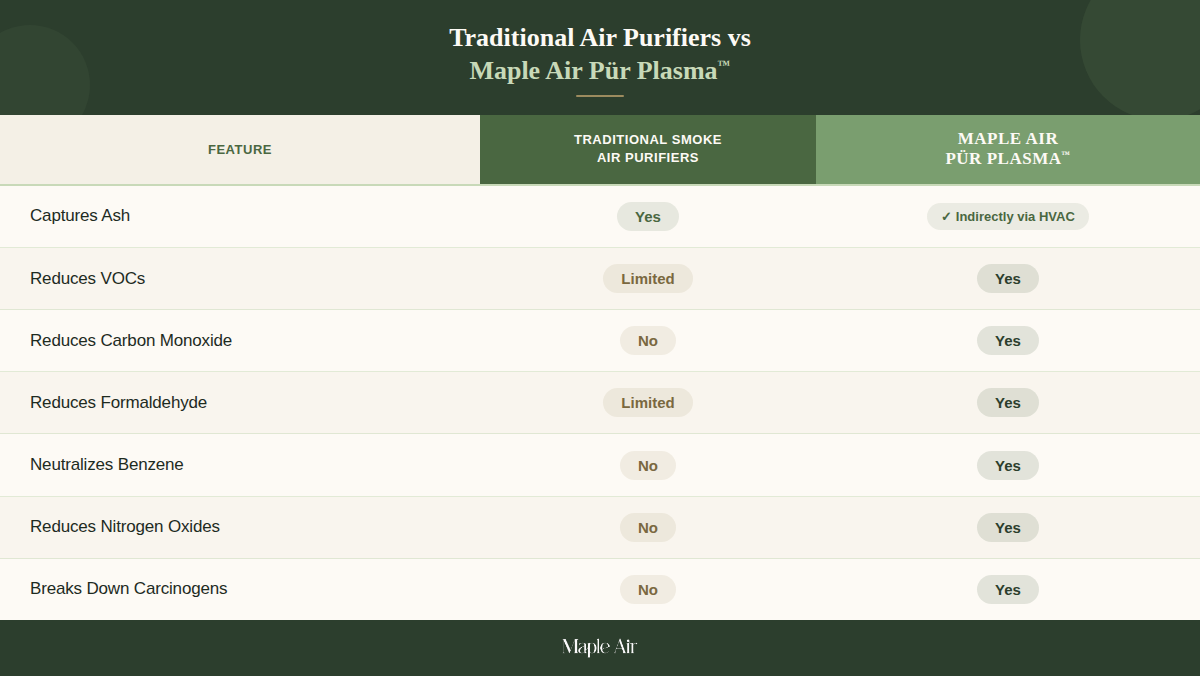
Building on this comprehensive approach, Maple Air Pür Plasma™ technology offers a more comprehensive approach than standard air purifiers by targeting both particles and the chemical compounds – including harmful gases – that cause odors and potential health risks.
The proprietary Pür Plasma™ technology generates cold atmospheric plasma as air moves naturally through your home. This process produces reactive molecules and free electrons, including:
These reactive particles have high electron energy that can break the molecular bonds in hazardous gases like those found in tobacco smoke. Rather than simply trapping these gases in a filter that needs to be frequently replaced, the plasma technology dissociates them into their harmless elements, which both eliminates odors and reduces chemical hazards.
Independent laboratory testing has evaluated how true plasma technology affects specific tobacco smoke gases. In controlled conditions, Maple Air systems demonstrated reductions of more than 90 percent in several key compounds commonly found in cigarette smoke, including:
These tests focused on individual gases that could be measured accurately. While tobacco smoke contains many additional chemicals, each of the compounds tested so far showed successful reductions.
Cigarette smoke is a mixture of microscopic particles and chemical gases that behave differently in indoor air. Traditional air purifiers can capture many smoke particles, helping to improve air clarity. But the gases and VOCs responsible for odor and chemical exposure often require more than standard filtration.
Maple Air Pür Plasma™ technology focuses on the chemical side of the problem. By interacting with smoke gases at the molecular level, the system has demonstrated reductions in compounds such as formaldehyde, benzene, nitrogen oxides, carbon monoxide, and benzo[a]pyrene.
In spaces where tobacco smoke is a persistent concern, Maple Air Pür Plasma™ addresses both particles and smoke gases, providing a comprehensive solution for cleaner, healthier indoor air. To learn more, contact us at info@getmapleair.com.
Yes. The Maple Air Pür Plasma system is designed not only to capture smoke particles but also to target the harmful gases and chemical compounds in tobacco smoke. This dual-action approach helps reduce both visible haze and airborne toxins, making the air cleaner and safer.
Unlike standard air purifiers that mainly trap particles, Maple Air Pür Plasma uses advanced plasma purification to neutralize volatile organic compounds (VOCs) and other gas molecules responsible for lingering smoke odors. This means the smell is reduced more effectively, even in areas where smoke particles remain.
For homes, offices, or any space where smoke odor is a concern, Maple Air Pür Plasma™ not only captures particles but breaks down smoke gases at the molecular level, providing the most comprehensive solution.


Healthier air in
Indian Trail, NC
with Maple Air
1500 sq ft home
Air Bioburden
(microbe units per cubic meter of air)
Industry standard:
>300 = poor air quality,
<100 = healthy air quality
Lab: Scientific Air Solutions in Turlock, CA


Healthier air in
Marvin, NC
with Maple Air
4000 sq ft home
Air Bioburden
(microbe units per cubic meter of air)
Industry standard:
>300 = poor air quality,
<100 = healthy air quality
Lab: Scientific Air Solutions in Turlock, CA


Healthier air in
Matthews, NC
with Maple Air
5000 sq ft home
Air Bioburden
(microbe units per cubic meter of air)
Industry standard:
>300 = poor air quality,
<100 = healthy air quality
Lab: Scientific Air Solutions in Turlock, CA



Air improvement
Surfaces improvement

Air improvement
Surfaces improvement

Air improvement
Surfaces improvement

Air improvement
Surfaces improvement

Air improvement
Surfaces improvement

Air improvement
Surfaces improvement

Air improvement
Surfaces improvement
Every Piece Is Unique


Not all air purifiers work the same, and the technology inside makes a big difference in what actually gets removed from your air. This guide compares the most common systems and explains which ones are best equipped to handle the full range of indoor pollutants.

If you’re comparing ozone generators and air purifiers, it’s important to understand they work in very different ways. This article breaks down how ozone systems operate, their limitations and safety concerns, and why plasma air purification offers a more practical solution for everyday, occupied spaces.
Available nationwide