AVAILABLE NATIONWIDE. INSTALLED BY LOCAL PARTNERS.
Get an Estimate

AVAILABLE NATIONWIDE. INSTALLED BY LOCAL PARTNERS.

Picking the right air purifier for your home can feel overwhelming. With so many options on the market, it’s hard to know which system will actually keep the air healthy and safe. One factor that often gets overlooked is “time to reduction,” or how quickly a purifier neutralizes viruses, bacteria, mold spores, volatile organic compounds (VOCs), and other pollutants in the air and on surfaces.
Many purifiers advertise they kill 99% of pathogens, but those numbers usually come from small lab tests that don’t reflect real-life spaces. In homes, offices, gyms, and schools, speed matters just as much as the final result. HEPA filters can leave corners untreated, UV-C lamps only work if air spends enough time near the light, and ionizers or PCO systems lose effectiveness as airflow, bulbs, and internal catalytic components limit their performance.
Maple Air Pür Plasma™ works differently. Instead of waiting for contaminants to pass through a filter or under a lamp, as most air purifiers do, it treats air and surfaces continuously, neutralizing pollutants as they appear. This ongoing action allows Pür Plasma to reduce airborne pathogens anywhere from 45-60 times faster than popular UV or PCO systems. This is done via technology that is ozone and chemical free.
Think of air purifiers like a race. Two systems might eventually cross the finish line, but the faster one keeps you safer the whole way. The speed of purification matters because, like a race car completing more laps in the same time, a quicker system compounds protection every hour, reducing exposure to viruses, bacteria, ozone, gases, and other pollutants throughout your home or workplace. In real-world environments, germs are continually introduced as people enter and leave the space.
Slower systems let particles linger and resettle, increasing the amount of contaminants in your home or office. Even if pollutants are eventually removed, this prolonged exposure adds to the total biological load people encounter throughout the day.
HEPA filters, UV lamps, ionizers, and PCO systems may seem effective in lab tests, but in real-world conditions – with moving air, people present, and constant pollutant introduction – their performance often falls short.
Not all air purifiers are created equal, and the technology inside makes a significant difference in how quickly and effectively the air is cleaned. Two common approaches are Photocatalytic Oxidation (PCO) and Non-Thermal Plasma (Pür Plasma™ class).
PCO systems use UV light and a titanium dioxide catalyst to trigger oxidation, which can neutralize some airborne pathogens. But in everyday use, performance depends on several factors:
In actual spaces with people, PCO often struggles. It reduces airborne pathogens slowly, only treats surfaces indirectly, and adding ionization doesn’t typically improve performance.
Pür Plasma works in a completely different way. It creates a stable, energized plasma field that generates charged and oxidized molecules. These molecules neutralize contaminants as air moves naturally through a space, breaking them down at the molecular level rather than just trapping or moving them elsewhere. The system doesn’t rely on airflow speed or prolonged exposure, and its effectiveness doesn’t decline over time.
Field tests show Pür Plasma can disinfect up to 15 times more effectively than UV and ionizers in active spaces. Pathogens are neutralized as they appear to provide ongoing, real-time protection in homes, offices, gyms, and schools. This performance is consistent from a small apartment to a large casino.
Independent testing compared two popular PCO systems and Pür Plasma in a controlled 2,640 cubic foot lab using the bacteria Enterococcus faecium and virus Feline calicivirus. The tests were carefully designed to keep conditions consistent, including airflow, sampling locations, timing, and the use of representative microbes. Both systems ran continuously until the microbes were completely eliminated, achieving a full 7.7-7.9 log reduction.
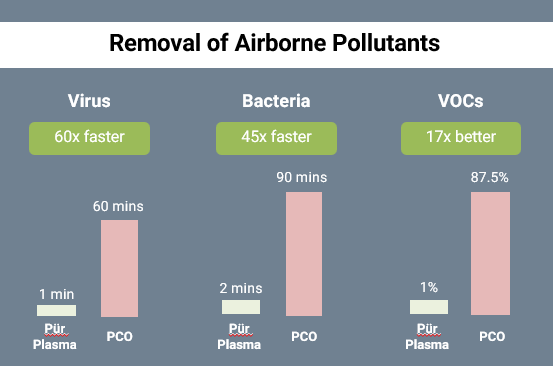
As the chart shows, Pür Plasma outperformed PCO-based systems dramatically, anywhere from 45-60 times faster.
Lab numbers are important, but they don’t tell the whole story. What really matters is how quickly a purifier protects the air while people are present. Systems like Maple Air’s Pür Plasma™ neutralize pathogens continuously, keeping air and surfaces safer in real time rather than waiting for contaminants to pass through a filter or under a lamp.
Faster air and surface treatment isn’t just a technical detail. It directly impacts the air you and your family breathe every day. Systems that work quickly to remove contaminants protect people when it matters most.
By completing more clean-air cycles in the same amount of time, these systems prevent pollutants from lingering and steadily reduce exposure throughout the day. Airborne viruses, bacteria, and mold spores are neutralized almost immediately, meaning pathogens are removed before they can be inhaled, lowering the risk of illness or allergy flare-ups.
Surfaces stay cleaner longer. Dust, droplets, and other particles naturally settle on tables, counters, and floors, but rapid air purification stops them from becoming a secondary source of contamination.
VOCs, odors, and wildfire smoke are broken down faster, helping rooms feel fresher and safer to breathe.
For homeowners seeking the best air purifier for allergies, asthma, viruses, mold, or wildfire smoke, speed makes a tangible difference. This is especially important in whole-house or large-room setups, where slower systems may leave distant corners active with contaminants for hours. A system that works efficiently protects the air wherever people live, work, and spend time.
When evaluating indoor air quality systems, consider:
Pür Plasma excels in all three, while PCO, UV, and ionizers face inherent limitations.
For PCO or UV systems, noticeable air improvement may take hours, leaving prolonged exposure. In contrast, Pür Plasma delivers measurable results in minutes, reducing airborne viruses, bacteria, mold spores, and VOCs almost immediately.
For homeowners asking “how long does an air purifier take to work?,” plasma-based systems start neutralizing contaminants the moment air enters the field, continuously protecting both air and surfaces.
Your home’s air quality is only as good as how quickly and consistently a purifier works. Because Maple Air’s Pür Plasma™ treats air and surfaces in real time, it’s the best choice for virus, mold, VOC, allergy, asthma, and whole-home protection. Faster time-to-reduction means less exposure, fewer infection opportunities, and healthier indoor spaces for everyone.
Want to see what faster reduction looks like in your home? Get an estimate from Maple Air and experience air quality that works at the speed it actually needs to.


Healthier air in
Indian Trail, NC
with Maple Air
1500 sq ft home
Air Bioburden
(microbe units per cubic meter of air)
Industry standard:
>300 = poor air quality,
<100 = healthy air quality
Lab: Scientific Air Solutions in Turlock, CA


Healthier air in
Marvin, NC
with Maple Air
4000 sq ft home
Air Bioburden
(microbe units per cubic meter of air)
Industry standard:
>300 = poor air quality,
<100 = healthy air quality
Lab: Scientific Air Solutions in Turlock, CA


Healthier air in
Matthews, NC
with Maple Air
5000 sq ft home
Air Bioburden
(microbe units per cubic meter of air)
Industry standard:
>300 = poor air quality,
<100 = healthy air quality
Lab: Scientific Air Solutions in Turlock, CA



Air improvement
Surfaces improvement

Air improvement
Surfaces improvement

Air improvement
Surfaces improvement

Air improvement
Surfaces improvement

Air improvement
Surfaces improvement

Air improvement
Surfaces improvement

Air improvement
Surfaces improvement
Every Piece Is Unique

Not all air purifiers work the same, and the technology inside makes a big difference in what actually gets removed from your air. This guide compares the most common systems and explains which ones are best equipped to handle the full range of indoor pollutants.

If you’re comparing ozone generators and air purifiers, it’s important to understand they work in very different ways. This article breaks down how ozone systems operate, their limitations and safety concerns, and why plasma air purification offers a more practical solution for everyday, occupied spaces.
Available nationwide